Key Features
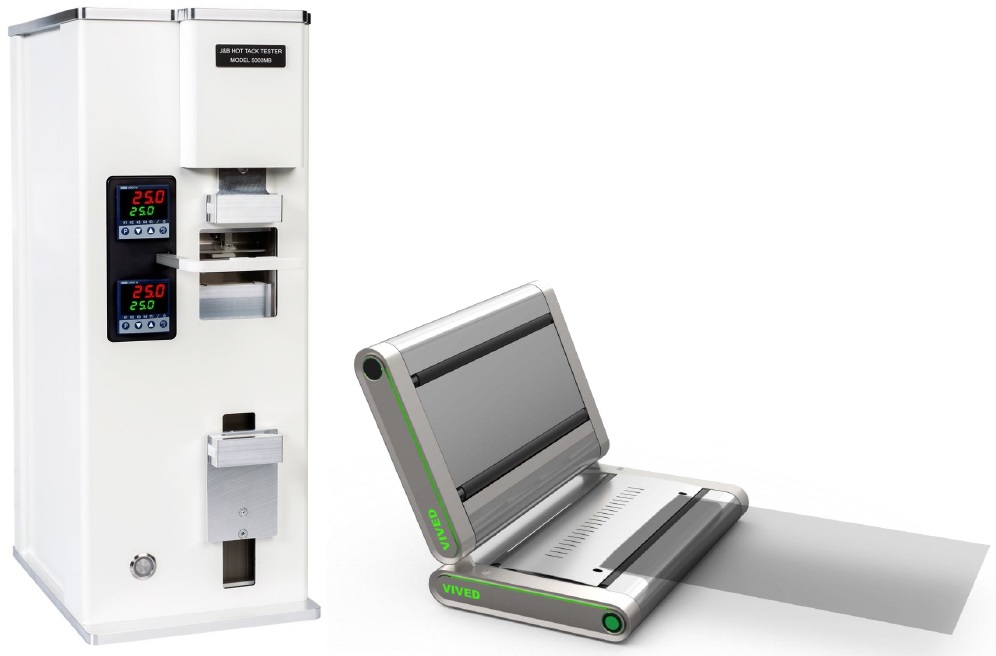
- Highly sophisticated instrument for testing sealing properties of packaging material as per ASTM F1921, used in R&D and in Statistical Quality/Process Control (SQC/SPC)
- Hot tack, peel-only, seal-only and rigid sample mode (rigid sample mode optional)
- Fully automatic, servo-motor-controlled sample folding and clamping for operator-independent, repeatable testing
- Niptef®-coated sealing bars with integrated heating elements and thermocouples hold the set sealing temperature constant regardless of ambient conditions
- Starting seal pressure of 0.05 N/mm², minimum sample size 250mm, maximum peeling distance 130mm
- Pneumatic, software-controlled protection plates for easy cleaning; maintenance-free design
- Optional: auto sample feeder and auto sample cutter, wider 10×50mm seal bar, higher force range up to 450N, and peeling speed up to 1000mm/s
What Is Hot Tack?
Hot tack is the strength of a heat-seal immediately after sealing — before it has cooled down and reached its maximum strength. Conventional testing with a separate heat sealer and tensile tester seldom correlates with the strength of a hot seal, since on a real packaging machine the seal is first put under stress while it is still hot.
The Hot Tack Tester simulates heat sealing on an automatic packaging machine: it makes a hot seal and then stresses it under precisely controlled, pre-programmed conditions, so lab results reflect what actually happens on the production line.
Sealing temperature, sealing time, sealing pressure, cooling time, peeling speed and sample width are all user-selectable, so the tester can simulate a wide range of different packaging machines and materials.
Why It Matters
- Research & development
- Optimizes packaging machine settings for new films and laminates
- Quality control
- SQC/SPC testing of raw materials, semi-finished and finished packaging
- Incoming inspection
- Verifies material sealability before it reaches the production line
How the Test Works
A fully automatic, four-stage cycle — from sample insertion to force measurement — with no operator intervention once it starts.
1. Set Up & Insert
The operator selects sealing temperature, time, pressure, cooling time, peeling speed and sample width in the Windows software, then inserts the sample.
2. Automatic Fold
The lower sample clamp moves into position and the sample is automatically folded between the sealing bars by a dedicated folding device.
3. Heat Seal
The sealing bars close and hold for the pre-set sealing time; once it elapses, they open and the heat seal is complete.
4. Cool & Measure
After the selected cooling time, the lower clamp peels the seal while a force transducer on the upper clamp measures hot tack force in real time.
Automatic Sealing Device
The sealing device sits in the front panel for easy access to its most-used components. Clamping plates activate automatically and hold the sample firmly during the test, while an electric motor drives the lower clamp for accurate, repeatable positioning and speed.
The fully automatic folding device aligns the sample perfectly, for fully operator-independent operation. The sealing bars are Niptef®-coated to prevent sample sticking, with integrated heating elements and thermocouples that hold the selected sealing temperature constant regardless of ambient temperature.
Sealing Device Parts
- 1. Sample clamps
- Automatically activated, hold the sample firmly during the test
- 2. Sample folding device
- Automatic, servo-motor-controlled, for perfect alignment
- 3. Sealing bars
- Niptef®-coated with integrated heating elements & thermocouples
- 4. Seal force transducer
- Piezo-electric sensor measures hot tack force during peel
Intelligent HotTack.Net Software
Modern Microsoft Windows® .NET software that’s easy to learn for a production operator, yet powerful enough for QC and R&D analysis.
Real-Time Force Graphs
Displays hot tack force versus time automatically after every test, plus summary correlation graphs of force versus any selectable variable.
Measurement Queue
Queue up single, multiple or stepped series of measurements before testing, and re-arrange, add or remove items mid-run.
Customizable Results Tables
Add calculated results to a sortable tabular view, with a waterfall display for comparing multiple measurements at once.
Editable Calibration
Calibration values can be reviewed and edited from within the program, keeping every measurement traceable.
Flexible Reporting
Export to Microsoft Excel®, merge results into a Word® template, or build custom exports with JavaScript.
Dockable, Custom Layouts
32/64-bit application with dockable windows, saved/restored layouts, and a Most Recently Used file list.
Correlation & Reference Graphs
View a correlation graph across a test series, compare it against a reference graph, and toggle included/excluded samples.
Print & Comparison Tools
Combine multiple hot tack files into a single Excel® file for side-by-side comparison, with print preview and saved print layouts.
Specifications
Testing Specifications
| Parameter | Detail |
|---|---|
| Sealing bars | 2, NIPTEF®-coated, including sensors and heaters |
| Seal bar size | 5×50mm (≈0.2×2″) or 10×50mm (≈0.4×2″) |
| Sealing operation | Asymmetrical or symmetrical, two-sided or one-sided |
| Sample width | Max. 40mm (1.6″) |
| Sample thickness | Max. 1mm (0.04″) |
| Sample length | Min. 250mm (9.8″) |
| Sealing time | 0.1–20 s |
| Sealing temperature | 21°C or ambient, up to 260°C (500°F) |
| Sealing pressure | 0.05–2.0 N/mm² (7.5–570 lb/inch) |
| Pressure & temperature control | Electronic PID, with strain-gage pressure sensor |
| Cooling time | 0.1–999 s |
| Peeling speed | 8–600 mm/s (0.32–23.6 inch/s), optional up to 1000 mm/s |
| Peel control | Vertically moving lower clamp, electric servo motor |
| Hot tack force range | 0–45 N, or 0–450 N as an option (auto-scaling) |
| Force sampling | Up to 20 kHz (peel-speed dependent), 1000 samples per measurement, 12-bit ADC |
| Force sensor | Piezo-electric force transducer |
| Sample clamps | 2 automatic, air-activated, clamping force >100 N |
| Sample folding | Automatic, servo-motor-controlled |
Software, System & Design
| Parameter | Detail |
|---|---|
| Software compatibility | Microsoft Windows® 7, 8, 8.1 and 10 (32/64-bit) |
| Recommended PC | Windows PC with inkjet or laser printer, USB interface to the instrument |
| Power | 90–264 VAC, max. 150 VA |
| Dry air supply | 6–8 bar (85–115 psi), ISO 8573-1:2010 class 7.4.4 |
| Weight | ca. 14 kg (31 lb) |
| Dimensions (W×D×H) | 220 × 287 × 556 mm (8.7 × 11.3 × 21.9 inch) |
| Design standard | Built to fulfil ASTM F1921 hot tack measurement requirements |
The optional higher-force sensor (0–450N) extends the measurement range but is less accurate than the standard 0–45N sensor.
Get A Free Instrument Consultation!
We can suggest products to our customers to make them the leaders in their respective industries.